
There is a meeting in your organization, held quarterly or thereabouts, in which the claims on your delivery capacity are settled. It has a name like portfolio review or investment board, it runs for 3 hours, and everybody leaves it slightly dissatisfied. The papers went round late. The list of candidate work was longer than the capacity to do it, by a factor of about two. And the items that survived were not, taken as a group, the items with the best economics. They were the items whose sponsors were in the room, or had spoken to the chair beforehand, or had already promised a date to a customer, or had simply asked more times than anybody else.
This is usually described as a problem of competing priorities, and the phrase is honest: there really is more work than capacity, and every request on the list matters to somebody. Where it stops is that it frames the meeting as a set of priorities to be balanced by judgment. What decides the outcome is not the priority of the work. It is the price each sponsor is willing to pay to win it.
Nobody in that room believes they are running a market. They believe they are exercising judgment. But look at what actually settled the outcome and every feature of a market is present: a scarce good, competing bidders, a price, and a mechanism that clears. The scarce good is hours of one overloaded team. The bidders are your business unit leaders. The clearing mechanism is the meeting. And the price, the thing a sponsor has to spend in order to win an allocation, is escalation: seniority, persistence, the willingness to make a fuss, the credit banked by not making one last time.
The effect deserves a name, because an unnamed mechanism gets defended as good judgment rather than examined as a design. Call it the escalation auction: the allocation mechanism a portfolio falls back on when its scarcest resource is rationed without a currency. It is not corrupt, it is not stupid, and it clears the market every single quarter without fail. It just happens to select on a variable that has no relationship whatsoever to return.
Competing priorities: what the escalation auction actually selects for
A price mechanism is supposed to carry information. When somebody pays a high price for something, the price tells you they value it, and it tells you so credibly, because paying it cost them something they could not simply manufacture. That is the whole reason prices are useful: they compress a great deal of private knowledge into a number a stranger can act on.
Escalation carries almost none of that information, for one specific reason. It is a currency the bidder can print. A sponsor's supply of persistence is not limited by anything the organization owns. Asking a fourth time costs the asker a few minutes and a little social friction. It costs the system a decision that is now being made on a variable nobody intended to optimize. When a currency can be printed at will by the people bidding with it, the resulting allocation reflects the distribution of willingness to print, and nothing else.
Watch what that produces, and notice that each of these is a pattern you can probably name in your own portfolio from memory.
It selects for proximity to the decision. Work sponsored by someone who sits two seats from the chair does better than identical work sponsored from a division three time zones away. Nobody intends this and it is nearly universal.
It selects for prior commitment. A sponsor who has already announced a date to a customer arrives with the decision pre-made, because reversing it now has a visible cost and a named owner. Committing early is therefore a winning strategy, which is why it happens a little more each year, and it is the reason so much of your constrained capacity is spoken for before any comparison takes place.
It selects for work with a face. A project with a named external customer beats a platform investment that would speed up 11 other projects, because the first has somebody to be disappointed and the second has nobody at all. Diffuse returns have no advocate at the moment of decision, which is the same structural blindness that makes cuts to shared capacity look free on the asymmetric ledger.
And it selects for whatever escaped the ranking entirely. Work below your governance threshold never enters the auction at all, so it consumes constrained hours without ever competing for them, which is the sub-threshold portfolio doing its quiet damage underneath the argument you are having.
None of these is a failure of the people involved. They are properties of the mechanism. And the mechanism is not a mistake somebody made, it is what appears by default whenever a scarce stock is rationed without anything to ration it with.
The same capacity, allocated two ways
Numbers make the shape concrete. The figures below are illustrative, but the pattern is one I have watched play out repeatedly.
A change portfolio runs everything through a platform and integration team of seven engineers. They are the constraint: nothing reaches production without them and everything queues for them. Each contributes about 29 productive hours a week once meetings, interruptions and administration are stripped out, across roughly 46 working weeks. That is 9,338 constraint-hours a year, and it is the true capacity of the organization to deliver change. An hour of that team returns about $1,050 of value, which is the value per constrained resource hour the enterprise is actually being paid on, and it makes annual throughput about $9.8 million.
Four business units compete for those hours. Between them they arrive each year wanting roughly 15,000. Nobody has ever written that comparison down in hours, because the requests are written in dollars and months.
Take one of the four. Business unit A brings three items to the board:
- Project P. 900 constraint-hours, $2.7 million of value. That is $3,000 an hour.
- Project Q. 600 constraint-hours, $780,000 of value. That is $1,300 an hour.
- Project R. 1,100 constraint-hours, $330,000 of value. That is $300 an hour. It is the replacement of an ageing internal system that has been promised to its users for 3 years, and its sponsor sits on the executive committee.
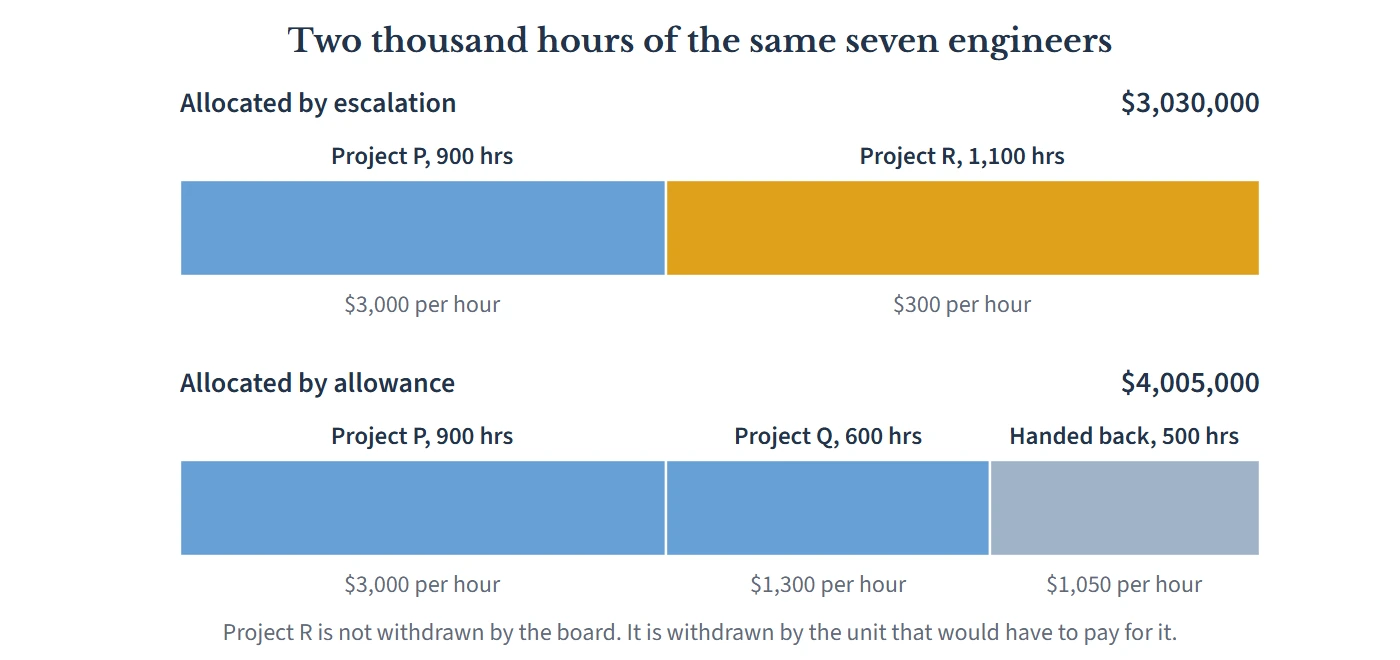
Under the escalation auction, A asks for all three, because asking is free and asking for less is unilateral disarmament. A does well, as A usually does. P is obviously strong and goes through. R goes through too, because of who is asking and because 3 years of promises have their own gravity. Q, which nobody has promised to anybody, is deferred to next year.
A has consumed 2,000 constraint-hours and produced $3,030,000 of value, a blended $1,515 an hour. Every step of that was defensible. Nobody lied.
Now run the same quarter with an allowance. The portfolio holds back 1,400 hours for mandatory work and variability, and issues the remaining 7,938 to the four units as constraint-hour budgets, sized by strategy rather than equally. A receives 1,800 hours and is told, in effect: this is yours, spend it on what you like, and when it is gone it is gone.
A now does the arithmetic it has never previously had a reason to do. P and R together are 2,000 hours, which A cannot afford. So the real question, for the first time, is what R displaces. Funding R means giving up Q. A knows perfectly well what Q is worth, because A runs the business Q serves. A withdraws R. Not under pressure, not after a fight with the board, not publicly at all. It simply stops being proposed, because the person who would have to pay for it can finally see the price.
A spends 900 hours on P and 600 on Q, which is 1,500 hours returning $3,480,000, and hands back 300 hours it cannot use well. Those 300 rejoin the pool and go to the next items on the ranked queue at, conservatively, the portfolio average of $1,050. So do the 200 hours A was never issued in the first place.
The same 2,000 hours of the same 7 engineers:
- Escalation auction: $3,030,000.
- Allowance: $3,480,000 from A, plus about $525,000 from the 500 hours released, or $4,005,000.
- A difference of about $975,000 a year, from one business unit out of 4, with no change in capacity, headcount, tooling or method.
The important part of that example is not the money. It is that nobody at the center had to rule on project R. Under the escalation auction, killing R means a portfolio director telling an executive committee member that their three-year promise is worth less than somebody else's project, using value figures the sponsor will immediately and correctly point out are estimates. That fight is unwinnable often enough that it usually is not had. Under an allowance, the fight never happens, because the decision moved to the only place where the information actually lives, which is inside A.
That is the real mechanism at work here. An allowance does not out-argue anybody. It relocates the argument.
The reason nobody can trust the numbers, and why it stops mattering
There is a standing objection to ranking work by economic return, and it is a good one. It is the argument made in the optimism gradient: the value figures in your business cases are not calibrated, they are advocacy, and the projects that attract the largest numbers are the ones whose numbers are hardest to check. Rank on those and you have automated your own credulity.
Notice what an allowance does to that problem. It does not solve it, but it neutralises it exactly where it does the most harm.
Under the escalation auction, inflating R's business case is free and effective. The hours come from a central pool, so the only thing standing between R and an allocation is whether the number survives a challenge in a meeting, and the number was written to survive challenges in meetings.
Under an allowance, inflating R's business case is free and pointless. A can write any figure it likes on R and it changes nothing, because the hours come from A's own budget and A would be spending them against Q. The holder of an allowance is not fooled by its own paperwork. For the first time, somebody with real knowledge of the work has a personal reason to compare two items honestly, and a cost if they get it wrong.
Be clear about the limit, because this is where the idea could be oversold. Allowances make value claims self-policing within a holder and do nothing about them between holders. Deciding that A gets 1,800 hours and B gets 2,400 is still a judgment made at the center on contested numbers, and it is still hard. But it is one judgment, made 4 times a year, about the shape of the enterprise, instead of 40 judgements about individual projects on information the center does not have. That is a far better division of labor than the one you have now, in which the center attempts both and in practice manages neither.
Why nobody in your portfolio has a reason to give hours back
Here is the part of the current arrangement that costs the most and gets discussed the least.
Your organization already knows how to tell when a project should stop. The method is not a secret, it is a straightforward comparison of value remaining against cost to complete, and it is the subject of knowing when a project is no longer worth finishing. Ask any portfolio leader whether they have work in flight that no longer justifies its remaining spend, and after a short pause you will get an honest yes.
So why does so little of it stop? Not because nobody can see it. Because nobody who could stop it gains anything by stopping it.
Under central allocation, capacity released by a cancellation does not return to the person who released it. It returns to the pool, where it is allocated in the next escalation auction to somebody else. Worse than neutral, the release is read as evidence. A business unit that hands back 300 hours has demonstrated that it was over-provisioned, and next year's allocation is trimmed accordingly. The rational strategy under those rules is the one every experienced leader has already worked out: consume everything you were given, and hold reservations against work that is not ready, because a reservation is much cheaper than trying to get back into the queue.
That last behavior is expensive and almost entirely invisible. Hours booked against work that is not ready to run are hours that cannot be re-sold when the work fails to show up, which is the cost of starting before full kit expressed as an inventory problem rather than a scheduling one. Assume a modest 12% of the 7,938 issued hours sit in reservations that never convert. That is about 950 constraint-hours, roughly $1 million of annual throughput, held in a drawer by people behaving entirely rationally given the rules they were handed.
The fix is a rule change, not an exhortation. Make returned hours worth something to whoever returns them.
What an allowance has to be to work
Six design rules. Each of them exists because leaving it out is how this idea fails in practice.
Denominate it in constraint-hours, not money. A budget in dollars can be spent on anything, which means it can be spent on capacity you are not short of, and the market will cheerfully sell you a great deal of that. Only an allowance denominated in hours of the constrained resource rations the thing that is actually scarce.
Issue against real capacity, not nominal headcount. 7 engineers is not 7 times 37.5 hours. It is 9,338 hours a year once leave, meetings, training and operational interruption are taken out, and the gap between those 2 figures is the subject of phantom capacity. Issuing hours you do not have is monetary inflation with the usual symptom: every allowance is honoured on paper, none of them is honoured in practice, and within two quarters nobody believes the currency.
Do not issue all of it. Hold back a reserve for mandatory work, for genuine emergencies and for variability. Issuing 100% of the constraint is the same arithmetic error as loading it to 100%, and it produces the same result, which is the queue explosion described in the utilization trap. 15% held back is a reasonable opening position.
Let hours carry forward, and credit returns generously. Use it or lose it guarantees hoarding. Carry-forward removes the reason to hoard. Then go one step further and price notice, because capacity returned early can be re-sold and capacity returned late cannot: credit hours handed back at least a quarter in advance at 1.1 times, and hours abandoned in the final fortnight at 0.5 times. That single asymmetry turns your cancellation problem from an argument into a transaction.
Allow trades, and publish them. If B needs 200 hours this quarter and C can wait, let them deal, and record it. Trades give you something no ranking exercise can produce: a revealed internal price for constrained capacity, arrived at by two parties with real deadlines at stake. After a year of trades you will know what an hour of that team is worth far more precisely than any business case has ever told you.
Publish the exchange rate. Every holder should know the portfolio's value per constrained resource hour, because an allowance is only decision-useful if it can be compared against the alternatives: buying the outcome outside, automating the demand away, redesigning the work so it does not touch the constraint, or simply not doing it. An allowance without a published rate is a quota. With one, it is a price.
Why single-project management is blind to this
Ask which project in your portfolio is responsible for allocating the constraint well, and the question answers itself.
Under the Project Illusion, a portfolio is a set of independent projects, each with its own business case, its own plan and its own resources. Capacity, in that picture, is an input each project procures. It is not a stock, it is a supply, and the way you get more of it is to make a good case for it. There is nothing in that model that would suggest a rationing mechanism, because there is nothing in that model that is being rationed. So the question never gets asked, and in the absence of a designed mechanism the undesigned one takes over.
This is also why the escalation auction survives so comfortably alongside a perfectly good prioritization framework. Plenty of the organizations running one have a ranked list. The ranking is produced, circulated, and then overtaken during the quarter by expedites, reprioritisations and direct requests, each of which is an expedite paid for by everything behind it. The list was never the mechanism. The list was a recommendation submitted to a mechanism, and the mechanism was the auction. Nothing changes until you replace the thing that actually clears.
What to do instead
1. Count the stock before you issue any of it. You cannot run an allowance against a number you have not measured. Establish which resource sets your delivery speed, then establish its true annual hours once everything that is not delivery has been removed. If you have not done the first part, start there, because the rest of this article is arithmetic on top of it.
2. Run it as a shadow ledger for two quarters before it binds anything. Issue notional allowances, record what each unit asks for and receives under the existing process, and post the balances. Enforce nothing. You are doing two things: finding out how far over-issued the constraint already is, which is usually a shock, and letting holders discover what their requests cost before the discovery gets expensive. A currency introduced by decree gets litigated. One introduced by a visible ledger gets adopted.
3. Issue quarterly, not annually. An annual issue commits your scarcest capacity on the least information you will ever have, which is the trap described in the frozen portfolio. Quarterly issuance with carry-forward gives holders enough stability to plan against and gives you four chances a year to move capacity towards what is working.
4. Charge everything that enters the queue, including the work that currently skips it. An allowance only rations what it can see. Small requests, favors, operational asks and anything under your governance threshold have to be charged against somebody's balance, or they become the route around the mechanism within a quarter. This is the same discipline as rewriting your thresholds in the currency that binds, and it is the step most often skipped.
5. Make the reserve visible and rank what comes out of it. The held-back 15% is where mandatory work, emergencies and returned hours live. Publish what it contains, what has been drawn from it, and how the remainder is ordered by return. A reserve nobody can see becomes a slush fund, and a slush fund is the escalation auction with extra steps.
6. Report throughput per constraint-hour, by holder, every quarter. One number per business unit: value delivered divided by hours consumed. Not a league table for its own sake, a feedback signal. Under the escalation auction nobody has ever been able to say whether A spends the organization's scarcest asset well or badly. After two quarters of this you will know, and so will A, and the second of those tends to change more behavior than the first.
The objection you are already forming
"We tried this. It was called chargeback, it consumed 18 months, it produced arguments about the cost model rather than better decisions, and we abandoned it. And underneath that, this is an abdication. You are handing portfolio strategy to four business units who will each optimize locally and collectively deliver an incoherent set of outcomes."
Both halves are fair, and both have answers.
On chargeback: the failure was in the denominator. Chargeback denominates in money and tries to recover cost, which imports every one of money's problems into the mechanism. Money is fungible, so a unit that dislikes your internal rate goes outside and buys capacity elsewhere, which usually generates more demand on the constraint rather than less. Money is also arguable, so the conversation becomes a dispute about overhead recovery and transfer pricing, which is a finance argument rather than a delivery one. An hour of your integration team is neither fungible nor arguable. It cannot be bought elsewhere, its quantity is a matter of observation rather than accounting policy, and there is nothing in it to litigate. You are not recovering a cost. You are rationing a stock, which is a different exercise that happens to look similar on a slide.
On abdication: the allocation of allowances is the strategy, and it is the part the center should be doing. Deciding that the growth division gets 2,400 hours and the mature division gets 1,200 is a sharper and more honest statement of enterprise intent than any strategy document, because it is denominated in the only thing that limits you and it cannot be answered in the affirmative for everybody. What the center gives up is not strategy. It is the adjudication of individual projects, on information it does not have, using value figures it cannot verify, against sponsors who frequently outrank it. That is not much of a loss. It has never worked, which is exactly why the same 11 contested items come back every quarter and why the honest answer to competing priorities has always been structural rather than procedural.
There is a version of the objection that is genuinely decisive, and it deserves naming. If your organization does not yet know which resource sets its delivery speed, or its capacity figure is nominal rather than measured, then you cannot issue a currency, because you do not know how much of it exists. Issue anyway and you will produce something worse than the escalation auction: an allocation that is just as political but now carries a number that makes it look objective. Measure first. The mechanism is only ever as good as the stock it is drawn on.
The uncomfortable summary is this. Your portfolio is already a market. It has been one for years, and the currency it clears in is the willingness of senior people to keep asking. That currency has three properties you would never knowingly choose: anybody can print it, it carries no information about value, and it is spent almost entirely by people who do not have to live with the trade-off. So the choice in front of you is not between a market and good judgment. It is between a market you designed and one that designed itself, and the second has been deciding what your organization delivers for as long as anyone can remember.
If you have not identified the resource that sets your delivery speed, start with How to Find the One Resource That Sets Your Delivery Speed, because there is nothing to issue until you have. For the rate that makes an allowance comparable to its alternatives, see Value per Constrained Resource Hour. And if you want to see what the current mechanism costs on a single decision rather than across a whole quarter, read The Price of Yes.

Leave a Reply