The Flow Economics Framework
A new field for portfolio decision-making
For decades, the management of multiple projects has been treated as an extension of project management.
Bigger plans. More governance. Tighter reporting. More sophisticated tools for tracking individual projects against individual baselines.
These things can help. But they do not solve the central portfolio problem.
Organisations still deliver less than they should. Strategic outcomes still arrive late. Capacity is still consumed without producing proportionate value. And the people running portfolios often know something is wrong, even when every project on the dashboard is green.
Flow Economics exists because portfolio performance is not simply a project management problem.
It is an economic one.
And it needs its own discipline.
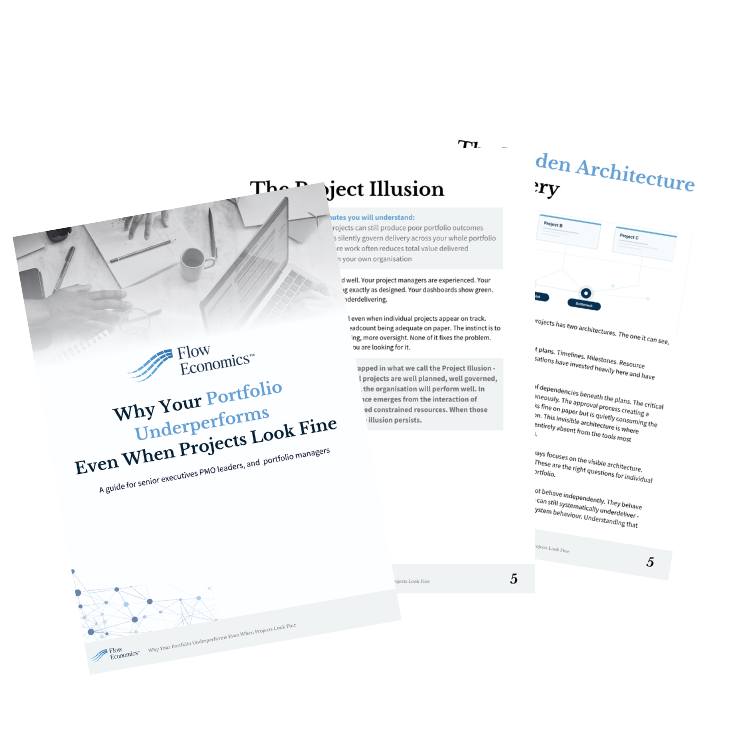
The Project Illusion
Many organisations are trapped in what we might call the Project Illusion: the belief that if individual projects are well planned, well governed, and delivered successfully, the organisation will perform well. In reality, portfolio performance emerges from the interaction of projects competing for shared constrained resources. When those constraints are invisible, the illusion persists.
This is the problem Flow Economics was created to address.
It is also why so much investment in PMO maturity, governance frameworks and delivery methodologies fails to move the needle on actual organisational performance. The thinking is anchored at the wrong level.
What Flow Economics is
Flow Economics is a framework for managing portfolios as economic systems rather than collections of projects.
It connects three things that are usually managed separately:
Value
the economic worth of outcomes, and the cost of delaying or diluting them.
Flow
how work actually moves through the portfolio, and where it slows down.
Constraints
the limited resources, skills or decision points that govern the pace at which value can be delivered.
These three lenses are not new in isolation. Value-driven project management, lean and flow thinking, and the Theory of Constraints have each contributed substantial bodies of work. What Flow Economics does is bring them together into a single decision framework, applied at the portfolio level, with an economic lens on every choice.
The result is a different way of running a portfolio. Projects stop being treated as isolated delivery items. They start being managed as investments competing for constrained capacity, each producing or destroying value over time depending on how they are sequenced, resourced and intervened on.
Why this is a field, not a method
A method tells you what to do; A field changes how you think.
Flow Economics is the second of those. It does not prescribe a fixed set of ceremonies, templates or governance structures. It provides a way of seeing the portfolio that changes the questions leaders ask - and therefore the decisions they make.
The questions Flow Economics teaches leaders to ask include:
Which work should enter the portfolio, given current constrained capacity?
Which projects are creating value fast enough to justify the resources they consume?
Where is delay creating measurable economic loss?
Which constrained resource, if relieved, would unlock the most portfolio value?
Where does intervention pay back, and where does it just shuffle the problem?
How does the organisation evolve from reporting on delivery to managing value?
These questions cannot be answered well at the project level. They require a view of the portfolio as a connected economic system.
The intellectual foundations
Flow Economics is not built from a single source. It draws on five connected streams of thinking.
Value-driven project management
Provides the economic language for understanding delay, investment health and project value over time. Stephen Devaux’s work on DIPP, Drag and Drag Cost is central to this foundation.

Multi-project resource allocation
Explains why portfolio performance cannot be understood by looking at projects one at a time. Albert Ponsteen’s academic work shows how shared resource contention creates effects that are invisible at the individual project level.

Theory of Constraints and systems thinking
Explain why the performance of the whole system is governed by its constraints, and why local optimisation often damages global results. Jan Willem Tromp brings this lineage directly into the Flow Economics worldview.

Computational portfolio economics
Makes these ideas usable in real organisations. Oleksii Mikhalevich’s work on drag calculation, capacity intervention and algorithmic portfolio analysis helps turn the theory into something that can be operationalised.
Throughput-based project management and the investment view of projects
Reinforces and extends the Flow Economics worldview. Mike Hannan’s Fruitful Project Management work, and his contribution as a co-author of PMBOK 8, have helped bring the language of investment, throughput and portfolio economics further into mainstream project management thinking. This stream strengthens the bridge between traditional project management and the economic view of portfolios that Flow Economics develops.
From PMO to VMO
One of the most visible implications of Flow Economics is the shift from the Project Management Office to the Value Management Office.
A PMO, in most organisations, is responsible for governance, reporting and delivery support. It asks whether projects are on track.
A VMO is an organisational unit accountable for value delivery across the portfolio. It is a group of people whose job is to make sure the organisation is investing in the right work, allocating constrained capacity to the highest-value uses, and intervening where economic loss is accumulating.
Want to see how this works in practice?
The first two modules of the Flow Economics course are free and introduce the foundations of the framework through practical examples.
Start the Free ModuleThe Flow Economics Maturity Model
Flow Economics describes six levels of organisational maturity, from purely activity-focused delivery to constraint-aware value optimisation across the portfolio.
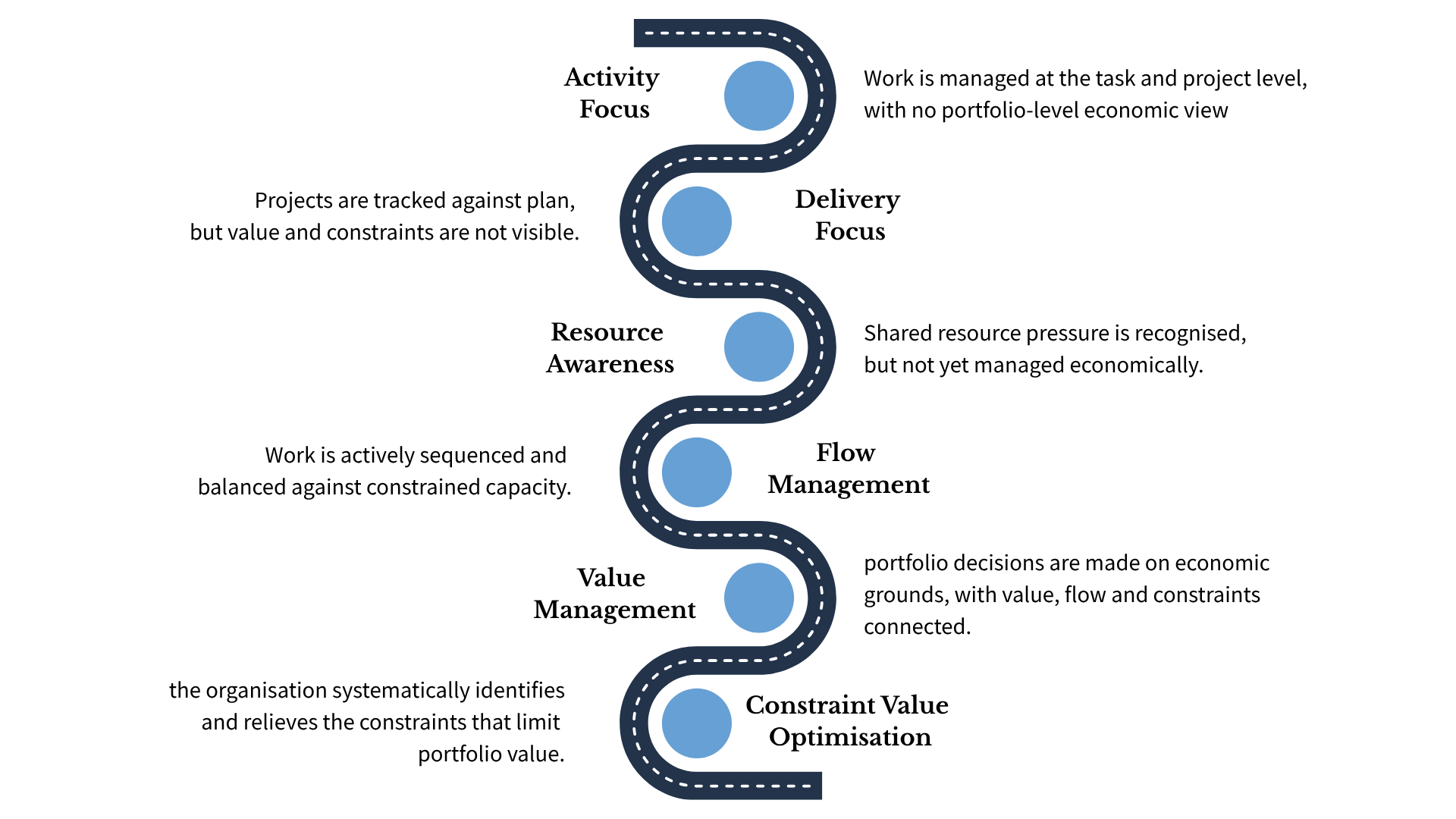
Most organisations sit between levels two and three. The transition from three to four is where Flow Economics thinking begins to deliver compounding returns, and where the PMO-to-VMO shift typically becomes visible.
Between levels four and five sits the Coordination Ceiling - the point at which further improvement requires not just better processes but a different economic worldview. Flow Economics is the framework for breaking through it.
Why this matters now
Three things are converging.
The first is that organisations are running out of road on traditional PMO maturity. Governance has been tightened, reporting has been improved, agile has been adopted at scale, and the underlying problem - too much work pushed through too few constrained resources - remains untouched.
The second is that PMBOK 8 has formally reframed projects as investments. This is a substantial shift in the dominant project management standard, and it makes economic thinking at the portfolio level increasingly difficult to avoid.
The third is that the tools to do this work, including portfolio simulators and shared resource management platforms, are now mature enough to support real decisions rather than just analysis. The thinking can be operationalised.
Flow Economics exists to give organisations the framework to take advantage of this moment.
What comes next
If this is the first time you have encountered Flow Economics, the easiest way to understand the framework is to start with the course. The first two modules are free and introduce the foundations of the framework.
The full course goes further into portfolio flow, value loss, constraints, Drag Cost, DIPP, the maturity model, and the use of a portfolio simulator to test decisions before making them in the real organisation.
Start the free modulesIf you would prefer to read more before committing to anything, the Flow Economics articles and the LinkedIn page are where new thinking is published as it develops.
Read the latest Flow Economics articlesFlow Economics
The layer between strategy and execution.
Understanding how value moves through multi-project organisations.