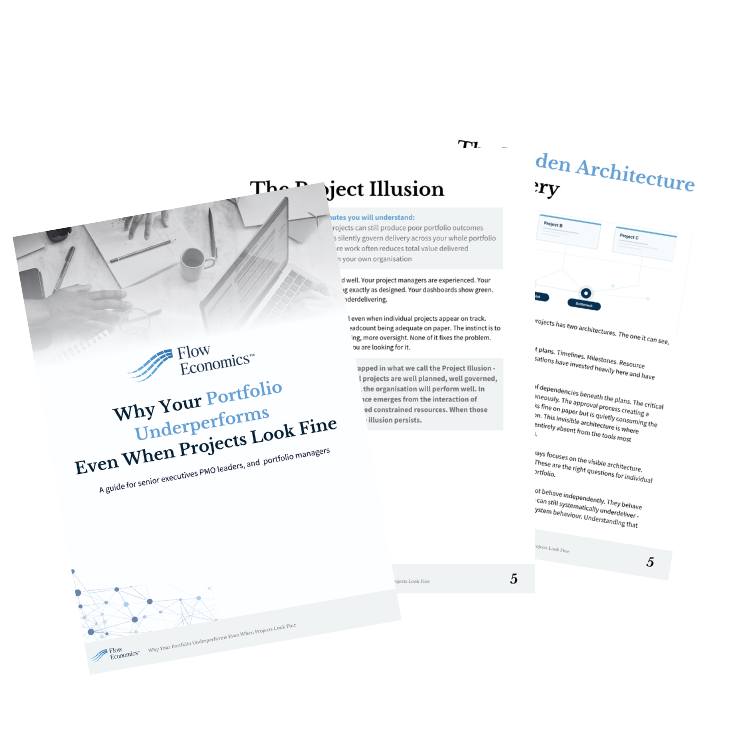
Flow Economics Course
From PMO reporting to portfolio value management
Most organisations do not fail because their people are not busy enough
They fail because too much work is pushed through the same constrained resources, priorities keep shifting, and decisions are made without seeing the economic impact across the whole portfolio.
The Flow Economics course helps PMO, portfolio and transformation leaders understand why this happens - and what to do about it.
It introduces the thinking behind Flow Economics, the move from PMO to VMO, and the practical use of flow, constraints and economic value in portfolio decision-making.
Modules 1 and 2 are free. Start there, no card required.
The full course (Modules 3 onward, including the simulator) is a one time payment of £349.
Why this course exists
Traditional portfolio management focuses on governance, status reporting and project-level control.
Those things matter, but they are not enough.
A project can look healthy in isolation while the portfolio as a whole is losing value. Teams can be working flat out while strategic outcomes are delayed. The PMO can be producing reports while the real constraint sits somewhere else entirely.
Flow Economics was created to address this missing layer between strategy and delivery.
It helps leaders answer better questions:
Which work should enter the portfolio?
Which projects should be accelerated?
Which delays are economically acceptable?
Which constrained resources are limiting value?
Where does intervention create the greatest return?
How does the PMO evolve into a Value Management Office?
This course gives you a practical introduction to that way of thinking.
What you will learn
By the end of the course, you will understand why portfolio performance is not just a project management problem. You will learn how value moves through a portfolio, how shared resource constraints affect delivery, and why the most important decisions are often made between projects rather than inside them.
The course covers:
- Why busy teams and successful projects do not guarantee a successful portfolio
- How shared resource constraints delay value across the whole organisation
- How to treat projects as investments rather than delivery items
- How Drag Cost and DIPP make the economic impact of delay visible
- What a Value Management Office actually does, and how the PMO evolves into one
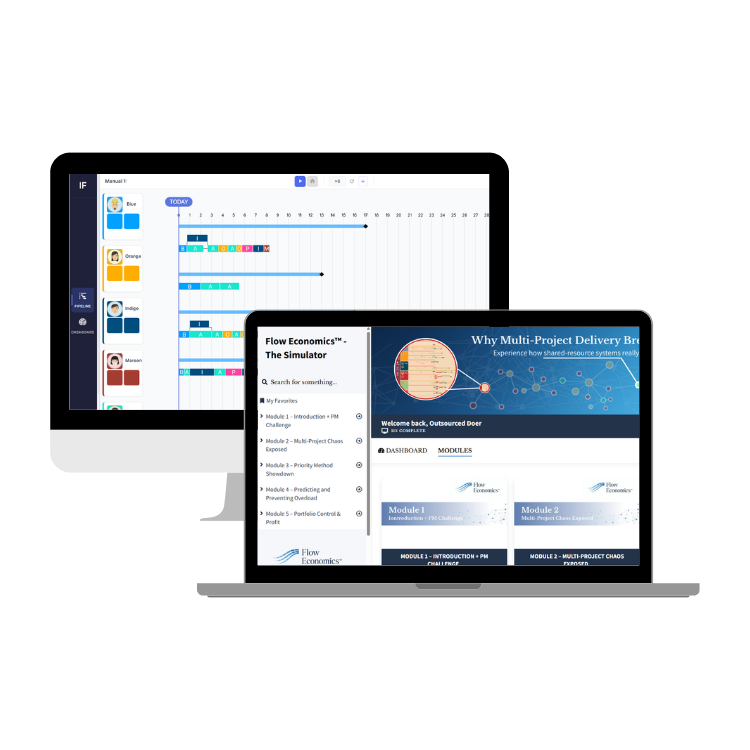
- How to use a simulator to see these effects play out in practice
Experience the portfolio problem, not just the theory
Most training explains concepts. This course lets you run them.
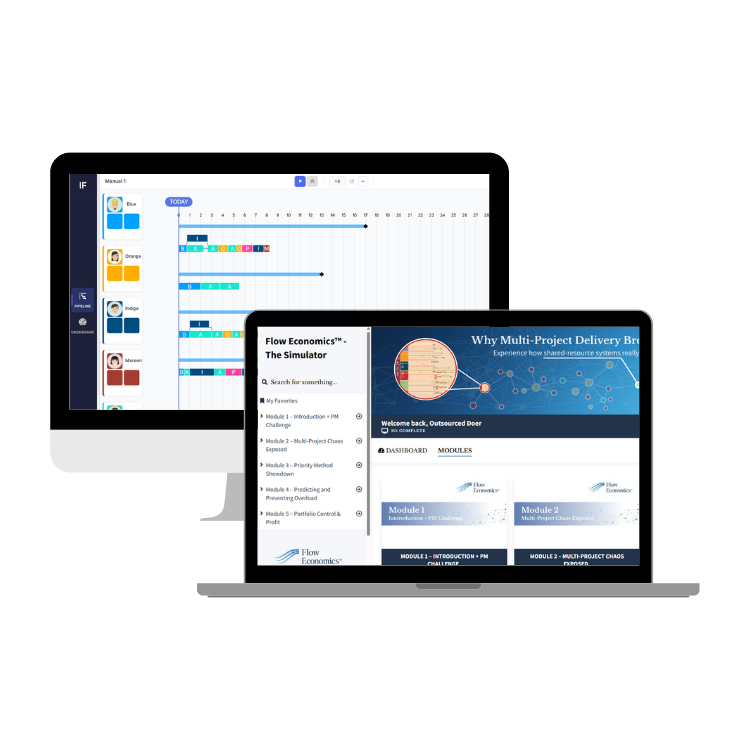
The Flow Economics simulator puts you in charge of a portfolio where multiple projects compete for the same limited resources. You make the sequencing calls, decide where to intervene, and watch the economic consequences in real time.
It matters because the right decision is rarely the obvious one. The project shouting loudest is not always the project losing the most value. Adding work can reduce output. Accelerating the right task can be worth more than accelerating the biggest project.
The simulator makes those effects visible in a way no slide deck can.
Who this course is for
This course is built for the people responsible for delivery performance across multiple projects and programmes:
PMO
leaders
Portfolio
managers
Transformation and
delivery directors
It is also relevant for resource managers, project controls professionals, and senior project and programme managers involved in moving from PMO to VMO thinking.
You do not need to be an economist or a scheduling expert. The course is designed to make the ideas practical, visible and usable.
Why PMO to VMO matters
Many PMOs are under pressure to prove their value.
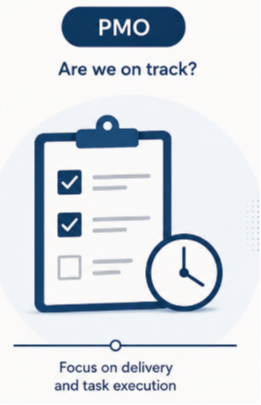
Reporting status is no longer enough. Leadership teams want to know whether the organisation is investing in the right work, whether capacity is being used effectively, and whether strategic value is being delivered fast enough.
That is where the Value Management Office comes in.
A VMO does not simply ask whether projects are on track. It asks whether the portfolio is delivering the greatest possible value through the resources available.
That shift requires a different view of work, capacity, priority and economic impact. Flow Economics provides the thinking behind it.
What makes Flow Economics different
Flow Economics is the only framework that connects three things most organisations manage separately:
Flow
how work moves through the portfolio and where progress slows down.
Constraints
the limited resources, skills or decision points that control the pace of delivery.
Value
what the organisation is trying to achieve, and what delayed delivery costs.
When these are viewed together, portfolio management changes. Projects stop being treated as isolated delivery items and start being managed as investments competing for constrained capacity.
That is the foundation of Flow Economics, and it is backed by a working simulator you can use to test decisions before you make them in the real organisation.
Course structure
The course is split into short, practical modules.
The first two modules are free and introduce the core ideas behind Flow Economics. The paid course continues into portfolio flow, value loss, constraints, Drag Cost, DIPP and simulator-based learning.
The course includes:
- Video lessons
- Interactive workbooks
- Practical examples
- Access to the Flow Economics simulator
- Exercises to help apply the thinking to your own environment
You work through it at your own pace.
What you will be able to do afterwards
After completing the course, you will be better equipped to:
✔
Identify where shared resource constraints are limiting delivery
✔
Explain why busy teams do not always create better portfolio outcomes
✔
Challenge project-level thinking with portfolio-level economics
✔
Understand the difference between PMO reporting and VMO decision support
✔
Use value, flow and constraints to improve portfolio decisions
✔
Recognise when delay is creating economic loss
✔
Use Drag Cost and DIPP in practical conversations
✔
Build a stronger case for evolving from PMO to VMO
Flow Economics
The layer between strategy and execution.
Understanding how value moves through multi-project organisations.