Your PMO was built to deliver projects. PMBOK 8 now says all projects are investments.
Flow Economics shows you how to run a portfolio that way.
Most PMOs already know the symptoms. Important initiatives slip. Key specialists are spread too thin. Teams stay busy, but throughput does not improve.
The gap between strategy and delivery is where most value is lost. It is rarely found inside one project, one team, or one plan. In shared-resource portfolios, performance is shaped by how work flows through the system and how investment decisions are actually made at the portfolio level.
Flow Economics helps PMOs operate that missing layer. It shows how demand, sequencing, and intervention decisions affect flow, output, and value across the portfolio. It is the practical operating logic that turns a PMO into a VMO.
Get the guide + first two course modules - freeSound familiar? Your PMO is running into the ceiling of delivery logic.

Your most strategic initiatives keep underdelivering on their expected return

Critical capability is trapped across too many concurrent investments

Portfolio priorities keep shifting, but value realisation does not improve

Teams are working harder, but the return on the time invested stays flat

New investments keep being approved, but too few actually deliver their value case
Why this is not a delivery problem
Projects do not operate in isolation. They compete for the same constrained capability.
Most PMOs are built around individual projects - governance, plans, status, reporting. That approach made sense when projects could be treated as standalone delivery units. But when multiple investments compete for the same constrained capability, the portfolio starts to behave in ways no individual project plan can explain or predict.
Queues form. Experts context switch. Progress slows. And the more investments you approve, the worse it gets - even when every one of them is genuinely valuable.
The Overload Paradox: approving more investments results in realising less value.
This is the ceiling traditional PMO practice keeps hitting. Managing the portfolio as a collection of projects cannot solve a problem that is fundamentally about the economics of the system those investments share.
What Flow Economics Is
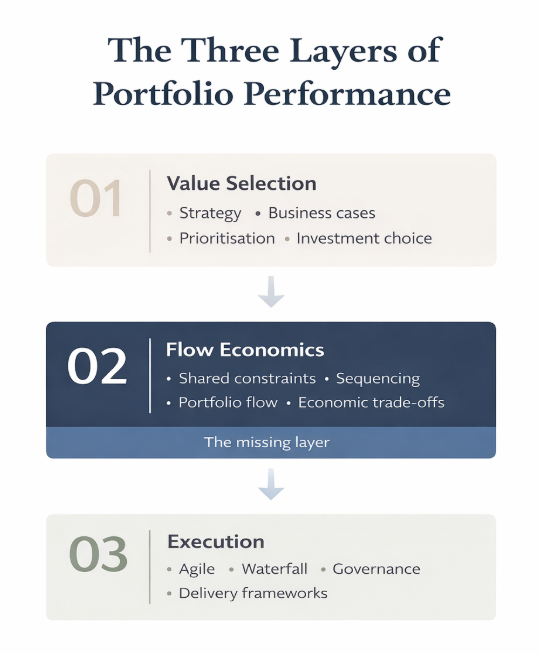
Flow Economics sits in the layer between strategy and execution. The layer where a PMO lives, and where a VMO has to operate.
Most organisations invest heavily in choosing the right initiatives and delivering them well. Both matter. But in shared-resource portfolios, value is often won or lost in the decisions between them. How work is sequenced. How constraints are managed. Where intervention creates the greatest return.
That is the question Flow Economics answers.
It is not another project methodology. It is not a delivery framework. It is the economic layer PMBOK 8 points towards when it declares all projects are investments. The missing operational logic that makes that shift real.
How do you maximise the value your organisation actually realises when resources are shared, priorities compete, and the portfolio never stops moving?
That is the problem Flow Economics is designed to solve. And it is the capability that separates a PMO from a VMO.
What You Get
Two practical resources. One email address. Both free.
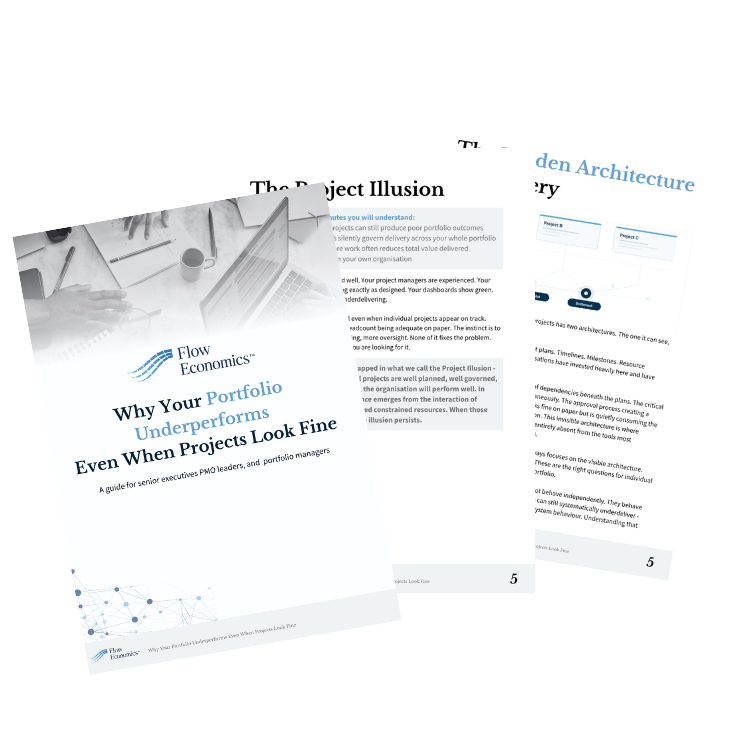
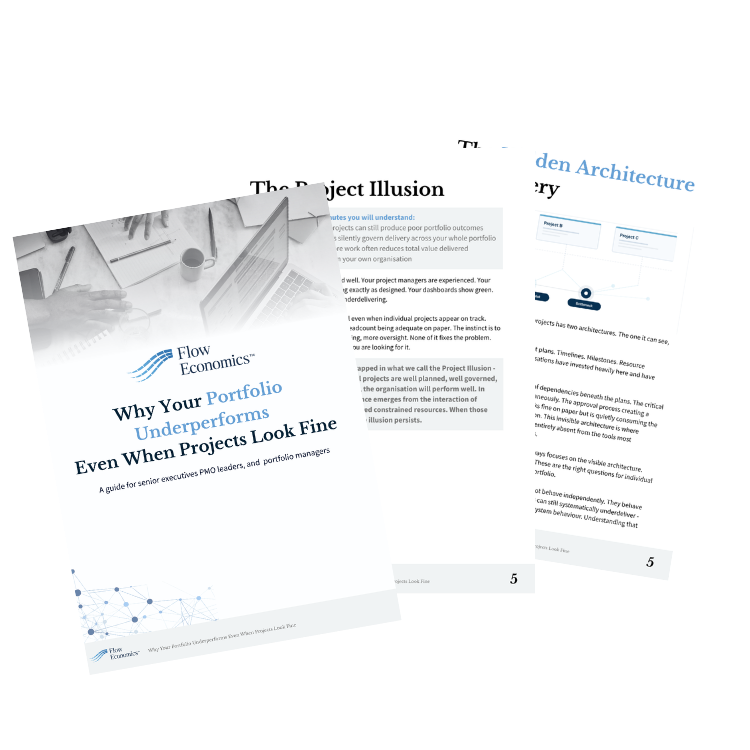
The Flow Economics Guide
A concise introduction to the core ideas behind Flow Economics. The Project Illusion, the Overload Paradox, the three-layer model, and a short self-assessment to help you see where your PMO stands today.
Delivered straight to your inbox as soon as you sign up.
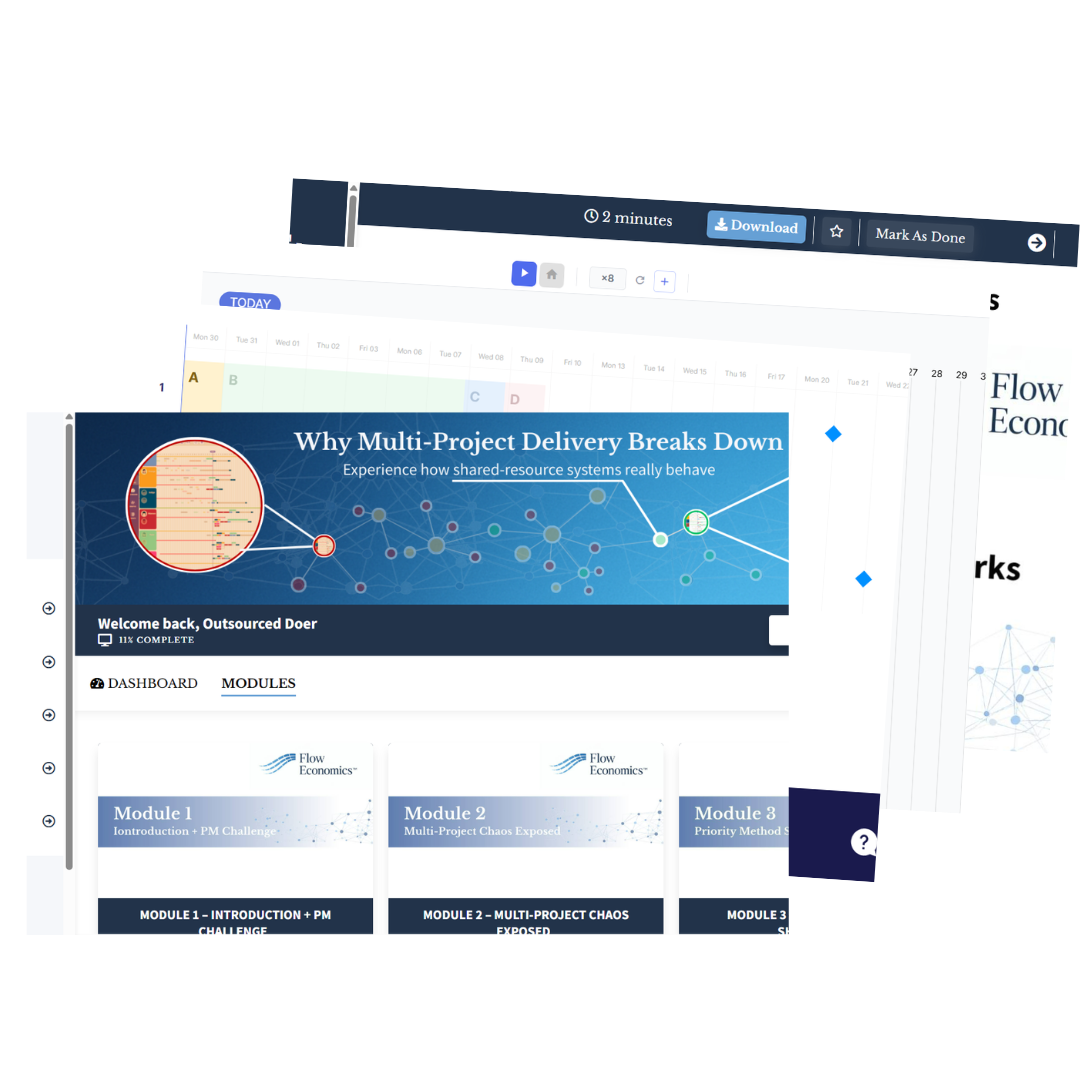
The Flow Economics Course
A practical introduction to how shared-resource portfolios really behave. Using the simulator, you will see how priorities interact, how overload emerges, and why better sequencing and intervention decisions are what turn a PMO into a VMO.
Access is immediate. No payment details are required.
Ready to operationalise the shift from PMO to VMO?
Get the guide and the first two course modules free.
No payment details. No commitment. Just a clearer way to understand how investment logic actually operates in a portfolio where resources are shared and priorities compete.
Get instant access - freeEnter your email to get started