
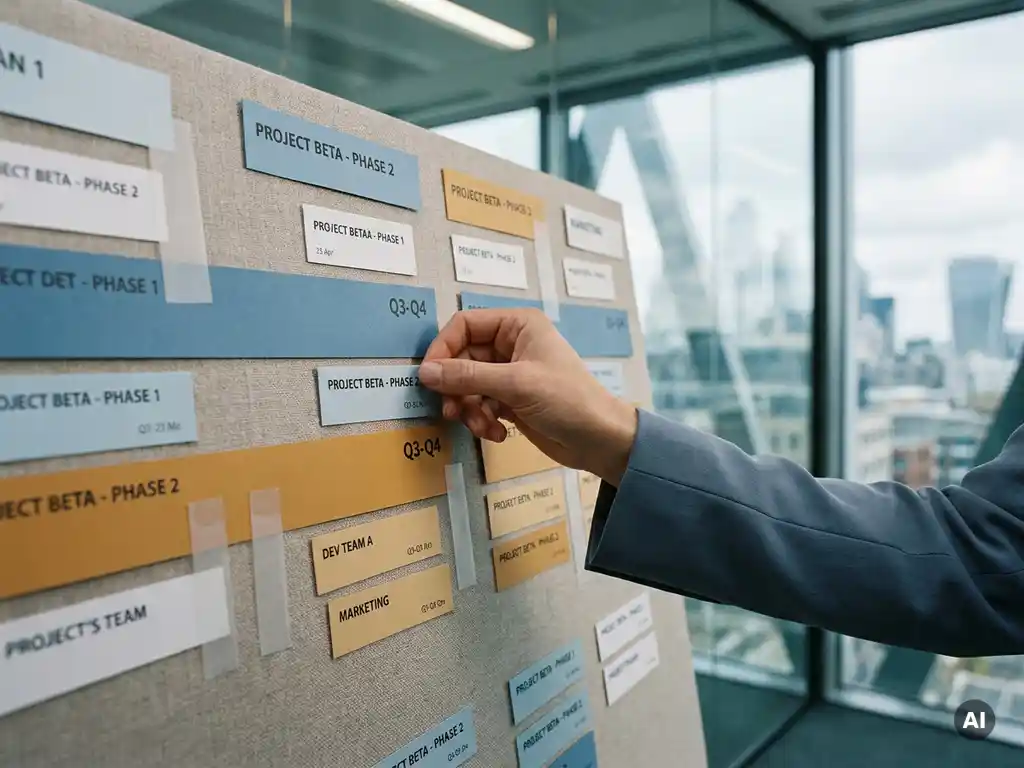
Resource leveling fits into portfolio-level planning in 2026 as a necessary but insufficient tool. It resolves scheduling conflicts within individual projects, but it does not address the deeper question of which projects should be running at the same time, in what order, and at what economic cost to the portfolio as a whole. Portfolio managers who rely on resource leveling alone are solving the wrong problem.
The gap between smooth resource allocation and strong portfolio performance is not a scheduling failure. It is a systemic one. The sections below work through the most common questions portfolio managers are asking about resource leveling this year, and where the real leverage sits.
Why does resource leveling break down at the portfolio level?
Resource leveling breaks down at the portfolio level because it was designed to solve a single-project problem. It adjusts task schedules to prevent a resource from being over-allocated within one plan. When that same logic is applied across ten or twenty projects competing for the same people, the algorithm has no way to decide whose schedule matters more. It can balance the load; it cannot price the delay.
The result is a technically smooth plan that hides a serious economic problem. When a specialist shared across four projects is leveled out of a conflict, one of those projects waits. That wait has a cost. It delays a benefit the organization was counting on. But because resource leveling tools report in hours and percentages, not in value, the cost is invisible.
This is the core of what Flow Economics calls the Project Illusion: the belief that if individual projects are well planned and well governed, the organization will perform well. In practice, portfolio performance depends on how projects interact when they compete for constrained resources. Resource leveling manages those interactions administratively. It does not manage them economically.
What is the difference between resource leveling and capacity planning?
Resource leveling is a scheduling technique that shifts task dates to eliminate over-allocation within a plan. Capacity planning is a strategic discipline that asks whether the organization has enough of the right skills to take on the work it is committing to. The two are related but operate at different levels of abstraction and serve different decisions.
Resource leveling answers: "How do we fit this work into the people we have?" Capacity planning answers: "Do we have the people to do this work at all, and if not, what do we stop or defer?"
At the portfolio level, capacity planning is the more important discipline. It forces a conversation about the portfolio as a system with real limits, not just a schedule to be optimized. The distinction between resource leveling vs resource smoothing is also worth clarifying here. Resource smoothing adjusts work within a fixed end date, accepting some over-allocation to protect the schedule. Resource leveling extends dates to eliminate over-allocation entirely. Both are scheduling tactics. Neither is a substitute for deciding what the portfolio should be doing in the first place.
How does resource leveling interact with portfolio prioritization?
Resource leveling and portfolio prioritization interact in a way that most organizations do not make explicit: the order in which projects receive constrained resources is, in practice, a prioritization decision. When a leveling algorithm pushes one project's tasks back to resolve a conflict, it is choosing which initiative gets value delivered first. That choice is rarely made on economic grounds.
In most organizations, prioritization happens through seniority and persuasion. The loudest sponsor wins the specialist. Resource leveling then formalizes that outcome in the schedule. The plan looks rational, but the underlying order of work was set by organizational politics, not by what the portfolio should earn.
A more coherent approach connects the two explicitly. Before leveling, the portfolio needs a sequencing logic: which projects should have first claim on constrained resources, based on what their delay costs. That sequencing logic then guides how conflicts are resolved, rather than leaving the algorithm to decide by default.
This is the shift from a structured portfolio (dashboards and governance) to what the Flow Economics Maturity Model describes as system-aware resource management: understanding the portfolio as a system with a constraint, where the order of work is set by the system rather than by whoever argues best.
What causes resource conflicts to persist even after leveling?
Resource conflicts persist after leveling for three main reasons. First, leveling is typically done at the point of planning, not continuously. Reality moves on. Estimates slip, scope changes, and new projects start. The leveled plan becomes stale within weeks, and the conflicts it resolved reappear in a different form.
Second, leveling addresses over-allocation but not over-commitment. An organization can have a perfectly leveled schedule in which every specialist is allocated at exactly 100% across their projects. That looks fine in a report. In practice, it means there is no slack anywhere in the system. Any disruption cascades immediately.
Third, and most fundamentally, leveling does not reduce the total amount of work in progress. It spreads it. When too many projects are running simultaneously on shared people, every project experiences more waiting time, more context switching, and more delay. The conflicts are a symptom of excess work in progress, not a scheduling error. Leveling the schedule does not fix that.
- Plans become stale quickly as reality diverges from the leveled baseline
- 100% utilization leaves no buffer for disruption
- Excess work in progress creates structural waiting that leveling cannot remove
- Conflicts resolved in the plan reappear in execution when priorities shift
Reducing work in progress, by actively limiting the number of projects running at any one time, addresses the root cause. Leveling addresses the symptom.
How should portfolio managers approach resource leveling in 2026?
In 2026, portfolio managers should treat resource leveling as one tool within a broader economic decision system, not as the primary mechanism for managing portfolio flow. The practical approach has three stages.
- Establish a sequencing logic before leveling. Decide which projects have first claim on constrained resources based on their economic value and the cost of delaying them. Stephen Devaux's work on drag cost gives a precise way to think about this: the drag cost of a constrained resource on a project is the value lost per unit of time that the constraint delays it. Projects with high drag cost on the constraint should be sequenced ahead of those with low drag cost.
- Identify the constraint before balancing the load. Most portfolios have one or two skill sets that limit the throughput of the whole system. Leveling across all resources equally obscures this. Knowing where the constraint sits changes the conversation from "how do we balance everyone?" to "how do we protect and exploit the bottleneck?"
- Reduce work in progress deliberately. Rather than leveling an over-committed portfolio into a technically smooth plan, consider whether some projects should be deferred entirely until the constraint has capacity. A smaller portfolio of well-resourced projects almost always delivers more value than a large portfolio of starved ones.
The underlying shift is from treating resource leveling as a scheduling problem to treating it as an economic one. The question is not "how do we fit this work in?" but "what order of work earns the most from the capacity we have?"
How Flow Economics helps with resource leveling at the portfolio level
Flow Economics provides a framework for the decisions that resource leveling cannot make on its own. Where leveling manages hours and task dates, Flow Economics connects those scheduling choices to economic outcomes. It gives portfolio managers a way to see the shared resource system as a whole, identify where the constraint sits, and sequence work based on what delay actually costs.
- It makes the cost of delay visible, so sequencing decisions can be made on economic grounds rather than by seniority
- It identifies the constraint in the portfolio, so resource decisions are focused where they have the most impact
- It connects flow and financial value into a single decision system, bridging the gap between scheduling and strategy
- It works with the methods and tools already in place, adding an economic layer rather than replacing what exists
If resource leveling is producing smooth plans that still underdeliver, the Flow Economics course is a practical starting point. Modules 1 and 2 are free and introduce the core thinking in about an hour. For questions about applying the framework to a specific portfolio context, the contact page is the place to start a conversation.